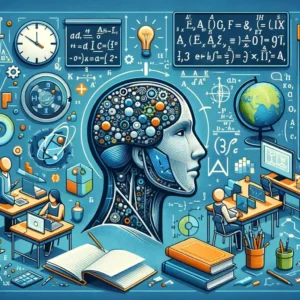

Mathematics has long been a subject that many students find challenging, but thanks to the rise of artificial intelligence (AI), learning math has never been more accessible or personalized. Whether you’re a student struggling with algebra, a parent helping your child with homework, or an adult brushing up on basic concepts, AI-powered tools can provide tailored support, instant feedback, and engaging ways to learn.
Why AI is Revolutionizing Math Education
Traditional math instruction often follows a one-size-fits-all approach, which doesn’t suit every learner. AI changes this by offering:
- Personalized learning paths
- Instant feedback and explanations
- Interactive problem-solving
- Adaptive difficulty levels
- 24/7 availability
These features make AI tools particularly useful for reinforcing classroom learning or studying independently.
Top AI Tools for Learning Math
1. Khan Academy + Khanmigo
Platform: Web & Mobile
Best For: K-12 through early college math
Khan Academy has long been a favorite among educators and learners alike. With the addition of Khanmigo, its AI-powered tutor, students can now get real-time help with math problems. It guides users step-by-step through equations, explains concepts in simple terms, and adapts to individual learning styles.
✅ Pros:
- Free to use
- Covers a wide range of topics
- AI acts as a Socratic tutor, asking guiding questions
⌠Cons:
- Limited advanced math support compared to dedicated tools
2. Photomath
Platform: Mobile (iOS & Android)
Best For: Visual learners and problem solvers
Photomath allows users to scan handwritten or printed math problems using their phone’s camera and instantly provides step-by-step solutions. Its AI recognizes mathematical expressions and offers detailed breakdowns, making it ideal for checking work or understanding where you went wrong.
✅ Pros:
- Great for visual learners
- Works offline
- Supports graphing and word problems
⌠Cons:
- Some advanced features require a paid subscription
3. Wolfram Alpha
Platform: Web & Mobile
Best For: Advanced learners and professionals
Wolfram Alpha isn’t just a calculator , it’s a computational knowledge engine powered by AI. It solves complex equations, explains mathematical principles, and even generates graphs and visualizations. Ideal for higher-level math like calculus, statistics, and linear algebra.
✅ Pros:
- Powerful computational engine
- Excellent for STEM fields
- Explains results with depth
⌠Cons:
- Interface may overwhelm beginners
- Subscription-based for full access
4. Socratic by Google
Platform: Mobile (Android & iOS)
Best For: Students needing quick help across subjects
Socratic uses AI to analyze photos of math problems and delivers clear, concise explanations. While not exclusively a math tool, it excels at breaking down algebra, geometry, and trigonometry problems in an easy-to-understand way.
✅ Pros:
- Easy to use
- Integrated with Google services
- Free and intuitive
⌠Cons:
- Less interactive than other platforms
- Limited in-depth tutoring
5. Microsoft Math Solver
Platform: Web & Mobile
Best For: All-around math assistance
Developed by Microsoft, this free app helps solve math problems via scanning, typing, or drawing. It also connects to video tutorials and similar problems to reinforce learning. Powered by AI, it’s especially helpful for algebra, calculus, and statistics.
✅ Pros:
- Free and ad-free
- Multiple input methods
- Integrates with educational resources
⌠Cons:
- Not as robust for very advanced math
6. ChatGPT / GPT-4 (via OpenAI or third-party apps)
Platform: Web
Best For: Customized explanations and tutoring
While not designed specifically for math, ChatGPT and GPT-4 can explain concepts, walk through problems, and generate practice exercises. Many students use these models in conjunction with plugins like Wolfram Alpha for enhanced math capabilities.
✅ Pros:
- Versatile and customizable
- Can handle word problems and abstract thinking
- Available for multiple subjects
⌠Cons:
- May occasionally give incorrect answers
- Requires critical thinking to verify responses
7. ByteLearn
Platform: Web
Best For: Teachers and classrooms
ByteLearn is an AI tutor designed for educators to integrate into their teaching. It provides step-by-step guidance, real-time feedback, and data-driven insights into student performance.
✅ Pros:
- Tailored for classroom use
- Offers analytics for teachers
- Encourages independent learning
⌠Cons:
- Mainly aimed at schools and institutions
The future of math education is here , and it’s powered by AI. These tools offer something for everyone, whether you need help solving a quadratic equation or preparing for a calculus exam. By combining traditional math instruction with intelligent technology, students can gain confidence, improve comprehension, and enjoy a more engaging learning experience.
💡 Pro Tip: Use AI tools alongside traditional learning , they’re best when used to supplement classwork, not replace it.
✅ Summary Table
| Tool | Platform | Best For | Key Feature |
|---|---|---|---|
| Khanmigo | Web/Mobile | K-12 to Early College | AI Tutor, Step-by-Step Help |
| Photomath | Mobile | Visual Learners | Scan Problems, Instant Solutions |
| Wolfram Alpha | Web/Mobile | Advanced Math | Computational Knowledge Engine |
| Socratic by Google | Mobile | Quick Problem Solving | Photo Scanning, Clear Explanations |
| Microsoft Math | Web/Mobile | General Math Help | Multiple Input Methods |
| ChatGPT/GPT-4 | Web | Custom Explanations | Conversational AI Tutor |
| ByteLearn | Web | Teachers & Classrooms | Classroom Integration, Analytic |